paper_study/20260924-123832_60hz_hum_s5_report.md · raw markdown
GarageFly run report: 20260924-123832_60hz_hum_s5
Generated 2026-09-24T12:43:59 · condition 60hz_hum · seed 5 · 30 s simulated (324 s wall)
Setup
- Stimulus: 60 Hz mains hum with harmonics, loudness-matched
- Audio source:
synthetic:hum:{'freq': 60.0} - Playback level: 85 dB SPL RMS at 1 m (track_rms); ambient noise 30 dB SPL
- Speaker distance from start position: 355 mm
- Baseline (silent) period: 0–10.0 s; stimulus period: 10.0–30.0 s
- Brain: sensory-motor mode, 52,547 neurons, 5,540,690 connections (FlyWire v783)
- Software: Python 3.12.13, PyTorch 2.14.0+cu130, MuJoCo 3.9.0, GPU NVIDIA GeForce RTX 3090
Key observations (this run)
Physics QA: passed (no jumps > 1 mm per 10 ms; thorax height stayed 0.5–2.5 mm above the surface; max step 0.80 mm).
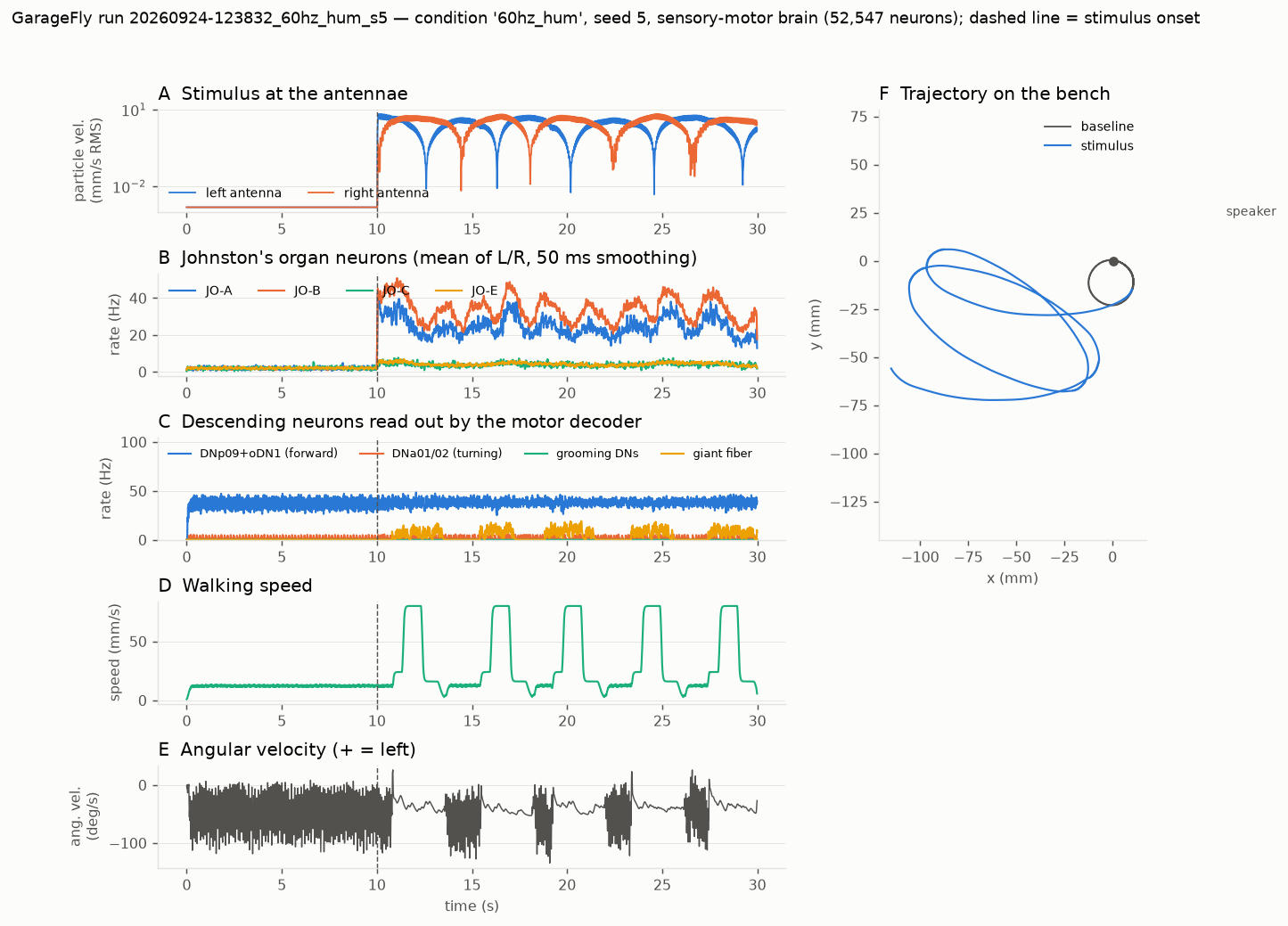
- Auditory Johnston's-organ neurons (JO-A/B, mean of both sides) fired at 29.2 Hz during the stimulus vs 2.0 Hz at baseline.
- Wind/gravity-sensitive JO-C/E neurons: 4.1 Hz vs 2.0 Hz.
- Mean walking speed was 11.57 mm/s during the stimulus vs 11.99 mm/s at baseline (-3%).
- Turning bias: -42.3 deg/s vs -46.6 deg/s (+ = leftward); freezing fraction 0.00 vs 0.00.
- Giant-fiber (escape) DN rate: 4.4 Hz vs 0.0 Hz; 5 escape-command episodes during the stimulus (0 at baseline). Each can trigger a takeoff unless the fly is already airborne or within the post-landing refractory period.
- Behaviour: walking 32%, grooming 0.0%, flight 68% of the stimulus period (15.0 takeoffs/min, 0.0 grooming bouts/min) vs walking 100%, grooming 0.0%, flight 0% at baseline.
A single run is one stochastic sample. Differences between baseline and stimulus within a run, or between single runs, are not statistically established. Use
scripts/compare_conditions.pyover several seeds per condition for inferential statistics.
Behaviour
| Measure | Baseline | Stimulus | Change |
|---|---|---|---|
| Fraction of time walking | 1.00 | 0.32 | -0.69 |
| Fraction of time grooming (body) | 0.00 | 0.00 | 0.00 |
| Fraction of time in flight | 0.00 | 0.69 | 0.69 |
| Takeoffs per minute | 0.00 | 15.00 | 15.00 |
| Grooming bouts per minute | 0.00 | 0.00 | 0.00 |
| Righting events (fell over) | 0.00 | 0.00 | 0.00 |
| Mean walking speed while walking (mm/s) | 11.99 | 11.57 | -0.41 |
| Distance travelled (mm) | 119.95 | 620.22 | 500.28 |
| Fraction of time freezing | 0.00 | 0.00 | 0.00 |
| Mean | angular velocity | (deg/s) | 46.71 |
| Turning bias (deg/s, + = left) | -46.56 | -42.33 | 4.23 |
| Fraction of time grooming command active | 0.00 | 0.00 | 0.00 |
| Escape (giant fiber) command episodes | 0.00 | 5.00 | 5.00 |
| Escape command episodes per minute | 0.00 | 15.00 | 15.00 |
| Fraction of time escape command active | 0.00 | 0.40 | 0.40 |
| Mean distance to speaker (mm) | 326.06 | 387.85 | 61.78 |
Neural activity: sensory input and descending output
| Neuron group | Baseline (Hz) | Stimulus (Hz) | Change (Hz) |
|---|---|---|---|
| JO-A (left) | 1.94 | 23.90 | 21.96 |
| JO-A (right) | 1.99 | 25.12 | 23.12 |
| JO-B (left) | 1.98 | 30.93 | 28.95 |
| JO-B (right) | 1.91 | 36.67 | 34.76 |
| JO-C (left) | 1.96 | 3.85 | 1.88 |
| JO-C (right) | 1.95 | 4.11 | 2.16 |
| JO-D (left) | 1.94 | 8.83 | 6.89 |
| JO-D (right) | 2.03 | 12.89 | 10.86 |
| JO-E (left) | 2.04 | 4.23 | 2.19 |
| JO-E (right) | 2.04 | 4.31 | 2.27 |
| JO-F (left) | 1.89 | 2.01 | 0.12 |
| JO-F (right) | 1.99 | 2.01 | 0.03 |
| DNp09 (left) | 30.78 | 30.96 | 0.19 |
| DNp09 (right) | 30.78 | 30.96 | 0.18 |
| oDN1 (left) | 46.17 | 48.19 | 2.02 |
| oDN1 (right) | 39.97 | 42.37 | 2.40 |
| DNa01 (left) | 0.00 | 0.00 | 0.00 |
| DNa01 (right) | 0.00 | 0.00 | 0.00 |
| DNa02 (left) | 0.00 | 0.00 | 0.00 |
| DNa02 (right) | 6.20 | 7.24 | 1.04 |
| MDN (left) | 0.00 | 0.00 | 0.00 |
| MDN (right) | 0.00 | 0.00 | 0.00 |
| aDN2 (left) | 0.00 | 0.00 | 0.00 |
| aDN2 (right) | 0.00 | 0.00 | 0.00 |
| DNg11 (left) | 0.00 | 0.00 | 0.00 |
| DNg11 (right) | 0.00 | 0.00 | 0.00 |
| DNg12 (left) | 0.00 | 0.00 | 0.00 |
| DNg12 (right) | 0.00 | 0.00 | 0.00 |
| GF (left) | 0.00 | 0.00 | 0.00 |
| GF (right) | 0.00 | 8.78 | 8.78 |
| MN9 (left) | 0.00 | 0.00 | 0.00 |
| MN9 (right) | 0.00 | 0.00 | 0.00 |
Neural activity by FlyWire super-class (mean rate per neuron)
| Super-class | Baseline (Hz) | Stimulus (Hz) |
|---|---|---|
| ascending | 0.0000 | 0.0010 |
| central | 0.0003 | 0.0132 |
| descending | 0.1619 | 0.3408 |
| endocrine | 0.0000 | 0.0000 |
| motor | 0.0564 | 0.0905 |
| sensory | 0.1261 | 0.8450 |
| sensory_ascending | 0.0000 | 0.0000 |
| unannotated | 0.0000 | 0.0000 |
Most responsive cell types (largest |change| stimulus − baseline)
| cell_type | super_class | n_neurons | baseline_hz | stimulus_hz | delta_hz |
|---|---|---|---|---|---|
| JO-B3 | sensory | 29 | 1.97 | 36.98 | 35.00 |
| JO-B1_c | sensory | 22 | 1.91 | 36.39 | 34.48 |
| JO-B1_b | sensory | 27 | 2.14 | 35.52 | 33.39 |
| JO-B2 | sensory | 36 | 1.81 | 33.22 | 31.41 |
| JO-B1_a | sensory | 105 | 1.94 | 32.20 | 30.26 |
| JO-B4_b | sensory | 25 | 1.97 | 30.99 | 29.02 |
| JO-B4_a | sensory | 15 | 2.01 | 27.92 | 25.91 |
| JO-A1 | sensory | 21 | 2.12 | 27.94 | 25.81 |
| DNg29 | descending | 2 | 0.05 | 22.50 | 22.45 |
| JO-A5 | sensory | 37 | 1.91 | 24.26 | 22.36 |
| JO-A3 | sensory | 6 | 2.02 | 24.14 | 22.12 |
| JO-A2 | sensory | 33 | 1.92 | 22.99 | 21.08 |
| JO-A4 | sensory | 2 | 2.15 | 20.10 | 17.95 |
| CB0478 | central | 2 | 0.00 | 14.75 | 14.75 |
| DNb06 | descending | 2 | 0.00 | 14.32 | 14.32 |
Most responsive downstream (non-sensory) cell types
| cell_type | super_class | n_neurons | baseline_hz | stimulus_hz | delta_hz |
|---|---|---|---|---|---|
| DNg29 | descending | 2 | 0.05 | 22.50 | 22.45 |
| CB0478 | central | 2 | 0.00 | 14.75 | 14.75 |
| DNb06 | descending | 2 | 0.00 | 14.32 | 14.32 |
| DNp12 | descending | 2 | 0.00 | 11.85 | 11.85 |
| CB3876 | central | 1 | 0.00 | 10.55 | 10.55 |
| DNg24 | descending | 2 | 0.00 | 10.22 | 10.22 |
| SAD053 | central | 2 | 0.00 | 9.43 | 9.43 |
| CB2789 | central | 4 | 0.00 | 8.12 | 8.12 |
| SAD013 | central | 2 | 0.00 | 8.00 | 8.00 |
| CB3911 | central | 1 | 0.00 | 7.35 | 7.35 |
| CB3913 | central | 1 | 0.00 | 6.60 | 6.60 |
| DNb05 | descending | 2 | 0.00 | 6.55 | 6.55 |
| CB0033 | central | 2 | 0.00 | 6.28 | 6.28 |
| DNp73 | descending | 2 | 0.00 | 5.42 | 5.42 |
| CB0466 | central | 2 | 0.00 | 5.40 | 5.40 |
Methods paragraph (draft, auto-generated)
A connectome-constrained leaky integrate-and-fire model of the adult Drosophila brain (FlyWire FAFB v783; 52,547 neurons and 5,540,690 connections in 'sensory-motor' mode; neuron parameters from Shiu et al. 2024) was simulated on a GPU at a 0.1 ms time step, in closed loop with the NeuroMechFly v2 body (FlyGym 2.1, MuJoCo 3.9.0). Audio (60 Hz mains hum with harmonics, loudness-matched) was calibrated to 85 dB SPL (RMS) at 1 m (track_rms calibration) and played from a virtual point source 355 mm from the fly's start position. Air particle velocity at each antenna was computed in 20 log-spaced bands (15–1500 Hz), including the acoustic near field and a cosine directional sensitivity. It was converted into Poisson firing rates of the FlyWire-annotated Johnston's organ neurons (JO-A to JO-E) through a resonant antenna filter and subgroup-specific frequency weighting. Descending-neuron activity (DNp09/oDN1, DNa01/DNa02, MDN, aDN2/DNg11/DNg12, giant fiber) was decoded into a two-dimensional locomotor drive for FlyGym's CPG-based controller, a grooming command (executed with measured front-leg grooming kinematics from an aDN-activated fly; Lobato-Rios et al. 2022) and an escape command (triggering an engineered takeoff-and-flight behaviour with externally applied lift; no wing aerodynamics). The first 10 s of each 30 s run were silent (baseline). Random seed 5.
Interpretation limits
- JO transfer functions, playback level, decoder gains and the tonic walking bias are arbitrary parameters (provenance in the run's JSON metadata). Conclusions should be checked for robustness to them.
- The ventral nerve cord is not simulated. Walking is produced by an engineered CPG controller driven by a few descending neurons.
- No substrate (bench) vibration, room acoustics, active antennal amplification, neuromodulation or gap junctions are modelled.
- Grooming uses measured kinematics but has no antennal contact mechanics. Flight is an engineered abstraction (applied lift/thrust, attitude PD); its speed, altitude and duration are arbitrary.
- Full list:
docs/MODEL_LIMITATIONS.md.
Files
- Raw data:
20260924-123832_60hz_hum_s5.h5(HDF5; behaviour, neural group rates, all spikes, stimulus) - Metadata:
20260924-123832_60hz_hum_s5.json - Machine-readable summary:
20260924-123832_60hz_hum_s5_summary.json